MUSCLE FOCUS / STUDY 01
Deltoid anatomy
for artists.
Understand the shoulder’s wrapping muscle: its shape, three parts, and the places it attaches to bone.
01 / READ THE FORM
One muscle, three parts
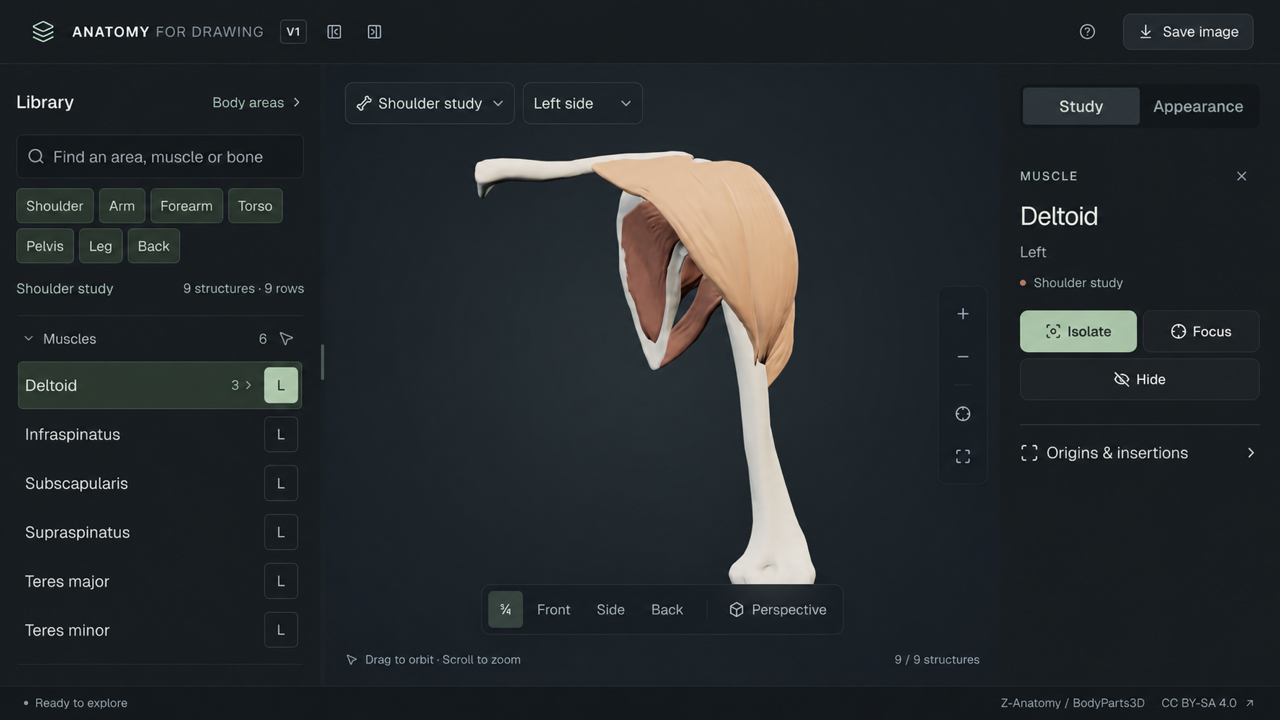
The deltoid wraps over the shoulder joint and narrows toward the outside of the upper arm. Its anterior, middle, and posterior parts give it a front, side, and back—not just a rounded cap.
In the screenshot above, follow the broad upper edge down toward the tapered attachment. For drawing, block in that whole volume first. Add the changes of plane as you turn around the model, rather than outlining three separate muscle patches.
Look closer in the studioChoose Shoulder study and select Deltoid. Expand its three parts in the library to inspect the anterior, middle, and posterior portions.
02 / FOLLOW THE ATTACHMENTS
Deltoid origin and insertion
- Origin: the outer third of the clavicle, the acromion, and the spine of the scapula.
- Insertion: the deltoid tuberosity on the outer surface of the humerus.
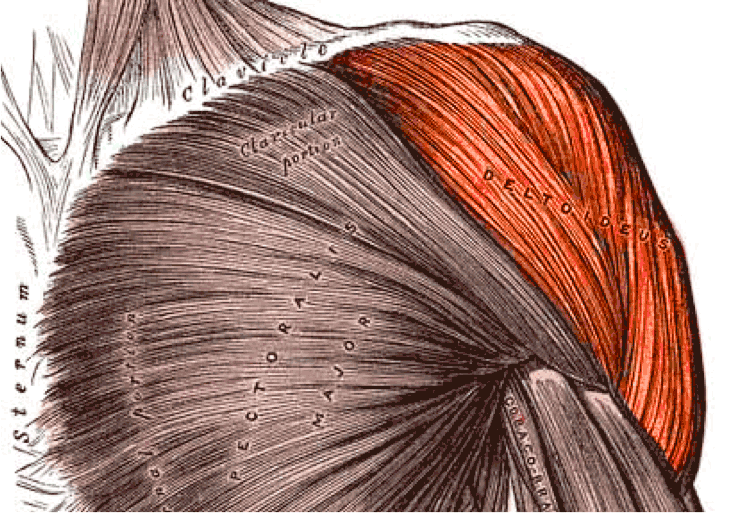
These attachments explain the broad shoulder wrap and the narrower endpoint farther down the arm. Use them to check where your drawn muscle begins and ends. Deltoid anatomy reference.
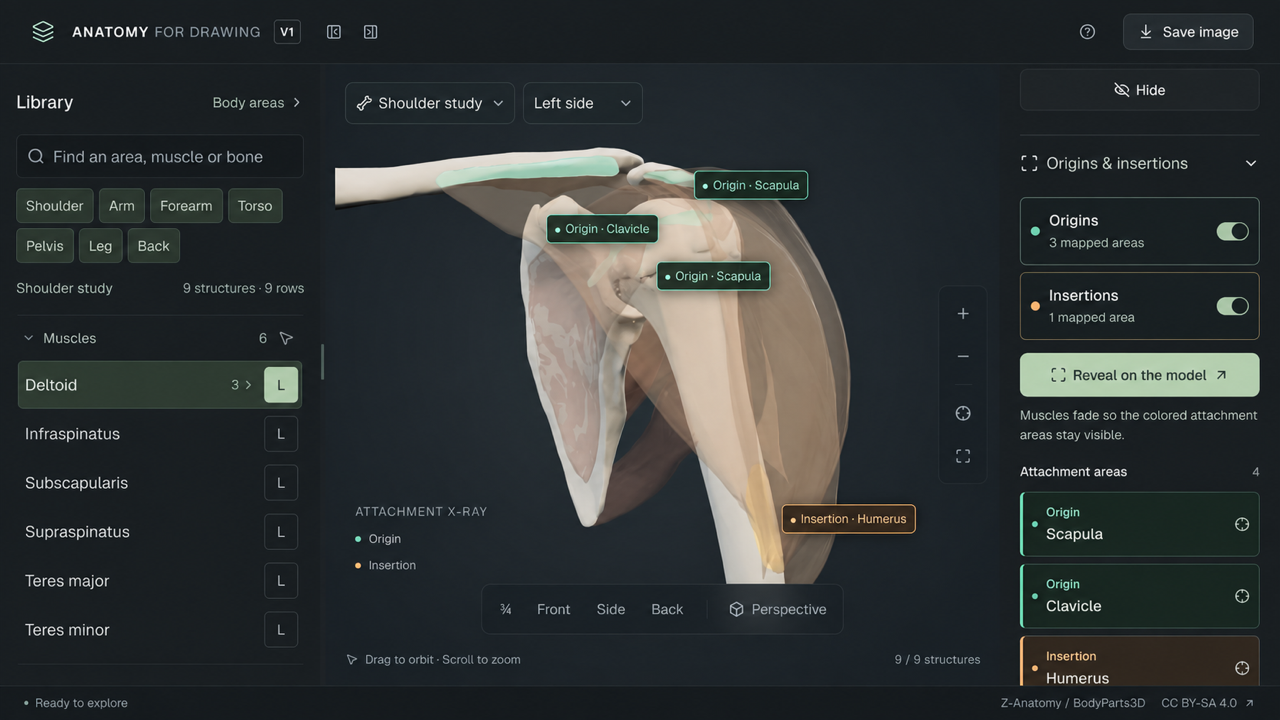
To see this view, open Origins & insertions and choose Reveal on the model. The muscle fades to expose the mapped attachment areas. Coverage varies between muscles in the explorer.
03 / TRY IT ON PAPER
A quick deltoid drawing study


- Mark the shoulder’s upper edge and the direction of the humerus.
- Wrap a broad muscle mass around the joint, tapering it toward the insertion.
- Orbit to a second view and check the front, side, and rear planes. Switch to clay material to simplify the light and shadow.
Keep the first sketch simple. The exposed model helps explain the structure; a photograph or life reference tells you which edges are actually visible beneath skin. The model has a fixed pose—rotating the camera does not move the shoulder joint.
Open the explorer and choose Shoulder study.
Reference & image credits
Anatomical reference: TeachMeAnatomy — Deltoid. Drawing prompts are suggestions for studying the form.
Screenshots captured in Anatomy for Drawing. Model data: BodyParts3D (DBCLS, CC BY-SA 2.1 JP) via Z-Anatomy (CC BY-SA 4.0), adapted by Souquet Consulting for Anatomy for Drawing. Our adaptation is released under CC BY-SA 4.0. Full attribution.